Modern infrared cameras are remarkable instruments. They are also remarkably easy to operate. Within a relatively short time, someone who has never used one before can produce a thermal image that looks impressive and, perhaps more importantly, convincing.
But when does operating an infrared camera become thermography?
That question matters because the camera and the thermographer have very different responsibilities. The instrument detects infrared radiation reaching its detector and converts that information into an image we can evaluate. It does not know what it is looking at, why a thermal pattern exists, or whether the conclusion we are about to draw from that pattern is correct. Those responsibilities belong to the thermographer.
When the Obvious Answer Isn't the Answer
During an aerial infrared inspection of a TPO roof on a restaurant in Winnsboro, Texas, the thermal imagery presented a pattern that could easily have been interpreted as a substantial moisture-related anomaly. Portions of the roof were radiating warmer than the surrounding membrane. Viewed only as a thermogram, the pattern offered a very tempting explanation: moisture beneath the roof covering.
But what did the image actually establish?
It established that a thermal difference existed. It did not establish the cause.
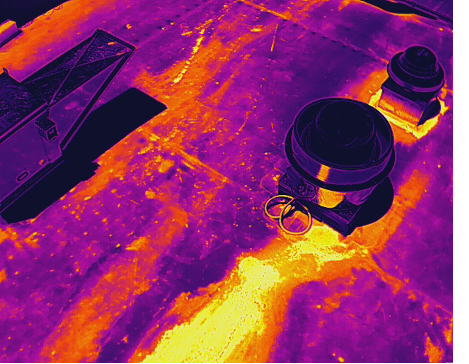
The investigation did not stop with the thermal image. Examination of the roof showed grease contamination of the TPO membrane associated with overspray from a dirty restaurant grease exhaust fan. A thermal pattern that could reasonably have supported one initial hypothesis had a very different explanation once the physical condition of the roof was considered.
So What Is Level I Really Teaching?
A student may enter Level I expecting primarily to learn how to use an infrared camera. Equipment operation is certainly part of the training, but it is only part of the foundation.
The student begins studying infrared theory, heat transfer, radiation, conduction, convection, emissivity, reflectivity, measurement considerations, image interpretation, inspection procedures, applicable standards, and reporting. As those subjects begin to fit together, something more important happens: the questions change.
Instead of simply asking what the camera is showing, the thermographer begins asking what physical mechanisms could have produced the apparent thermal pattern. That is not merely learning additional terminology. It is learning a different way to observe.
Consider emissivity and reflected energy. A surface may appear thermally different from the materials around it, yet the apparent difference may not represent the actual condition someone first assumes. The instrument can be operating exactly as designed while the observer assigns the wrong explanation to the radiation reaching the detector.
That is why thermography is not simply image acquisition. The image is evidence. Interpretation requires understanding the conditions under which that evidence was produced.
Where Does Level II Fit?
Level II builds upon the Level I foundation and moves further into quantitative measurement, measurement accuracy, calibration, error sources, advanced analysis, and increasingly complex applications. But I do not believe someone should pursue Level II simply because Level II comes after Level I.
Training should follow responsibility.
A commercial building inspector incorporating thermography into property assessments encounters different problems from someone inspecting energized electrical equipment. A thermographer evaluating a low-slope roof faces different environmental influences from someone examining an industrial process. Move the camera onto an unmanned aircraft and distance, viewing geometry, atmospheric effects, spatial resolution, and changing environmental conditions add another layer to the analysis.
The applications change, but the responsibility does not. Eventually someone must decide what the thermal information means and how much confidence can reasonably be placed in that conclusion.
Certification Is a Foundation
Certification matters because it establishes a disciplined technical foundation. It does not manufacture experience.
Experience develops afterward, often through situations where the obvious explanation turns out not to be the correct one. Those experiences teach a thermographer to question assumptions, make another observation, change the viewing angle, obtain additional information, or simply acknowledge when the available evidence does not yet support a conclusion.
Technology has made acquiring thermal information easier than at any previous time. It has not automated judgment.
Where Should You Begin?
For someone entering professional thermography, Level I is the logical beginning, not because it is simply the first certification in a sequence, but because it provides the foundation for understanding why thermal patterns occur rather than merely recognizing that they exist.
Before choosing a course, I would ask a different question. If someone makes an expensive maintenance, repair, or replacement decision based upon my thermal findings, am I prepared to explain how I reached my conclusion and defend the process that produced it?
If that question causes even a moment of hesitation, you may have just discovered what Level I training is really for.
Professional Infrared Education in Dallas–Fort Worth
DFW ASTM PROs offers Infraspection Institute Level I and Level II professional thermographic education in North Texas, with emphasis on disciplined observation, practical application, and professional judgment.